Saturday, April 30, 2016

"My Inner Fish"

One of the main themes in the two episodes "Your Inner Fish" and "Your Inner Reptile" is that humans and fish have a shared ancestry, and humans and reptiles are actually closely related. There is a lot of concrete evidence in fossils and embryos to support this.

In the initial stages, a human embryo and and fish embryo look very similar because of the common Hox genes, which suggest common ancestry. Other evidence for common ancestry includes some structures that humans and fish both have today: bony skeletons, backbones and skulls, and shared basic brain anatomy.
The Sonic Hedgehog gene sends out the organizing signal; it tells cells to do different things, and creates the array of digits on the hand. Hair, which is a defining characteristic of mammals today, may have first evolved in our small mammalian ancestors as a sensory organ or a tool to help keep warm.

Another example of humans' relation to reptiles is their hearing anatomy. Mammals have an acute sense of hearing because they have 3 bones in their middle ear which form a lever system, while reptiles only have 1 bone in their middle ear. Scientists think that two jaw bones in reptiles got smaller, moved further up the jaw, and evolved to have a new purpose in the ear in mammals.


Human and fish embryos look very similar initially because of Hox genes, indicating a common ancestry


Monday, April 18, 2016

20 time update: Surveying

During the past couple weeks, I have finished creating my questionnaire that I am using to determine whether people are at risk for diabetes and heart disease. I have also interviewed 3 people using this questionnaire, and I think that it is proving reasonably effective.

My questionnaire originally contained quite specific numbers to determine whether a person was at risk for diabetes or heart disease. However, as I did my first interview, I realized that the majority of people don't know their exact test results, and at most they will remember whether it was in the low, normal, or high range. I shifted my questionnaire slightly to measure people's awareness of their own risk factors. I also used their answers of results being in the low, normal, or high range to determine their level of risk.

My next steps are to continue giving the questionnaire to more people; the more people I include in my study, the more accurate it will be.


Friday, April 15, 2016

Invertebrate of Your Choice: Jellyfish

Jellyfish are invertebrates, and belong to the phylum Cnidaria. They are the oldest existing animals that have specialized tissue. Jellyfish are medusas (non-polyps). They are part of the scyphozoans class of Cnidaria. Jellyfish are found in every ocean, and are about 500 to 700 million years old. Jellyfish are the oldest animal to have multiple organs. They cannot see, but some do have ocelli, which allows them to detect light. Jellyfish come in a very wide variety of sizes, which can range from 1 mm in height to about 2 meters in height. They don't have a central nervous system, a digestive system, a respiratory or a circulatory system. They obtain their oxygen instead by diffusion through their skin.

Source: Wikipedia

Moon jellyfish 

Monday, March 28, 2016

Creating the Questionnaire

In the past two weeks, I've started creating my questionnaire for my 20-time project. I finished reading The South Asian Health Solution and I am much better educated about my topic now. I will be doing a study that will look at how South Asians are at high risk for diabetes and heart disease. Using the study to determine what each individual's risk factors are, I would like to help people who are at risk for diabetes and heart disease make lifestyle changes so that they can prevent this from happening.

My questionnaire so far has tried to address people's family history, amount of exercise, diet, amount of sleep per night, and certain levels, such as triglycerides, HDL, blood pressure, that should ideally be around a certain number.

My next steps are to continue writing my questionnaire, and I will start surveying people as soon as possible.

Wednesday, March 23, 2016

Unit 8 Reflection

This unit was about evolution; we looked at how populations evolve and how life on Earth originated. Evolution happens because genetic variation exists in populations. Variation is due to sexual reproduction, meiosis, and crossing over which happens during meiosis. Humans breed animals for both work purposes and for food, and this is called artificial selection. They select individuals with the trait they want and only mate individuals with this trait. A selection process also occurs in nature, natural selection. Nature favors certain phenotypes which are advantageous for survival and these individuals have a better chance of surviving, reproducing, and passing on their genes. The population evolves to look like these "winners", which was one of Darwin's conclusion about the evolution of populations. This principle was illustrated in The Hunger Games Lab where each there were three phenotypes, and the ones that were better for picking up enough food survived, and those who couldn't gather sufficient food fast enough died and didn't pass on their genes. The initial population in this lab did evolve, as we could see by the change in allele frequency.
Allele frequency change in the Hunger Games Lab

We can tell if a population evolved by looking at if the allele frequency has changed. Allele frequency is how common an allele is in a population. Natural selection can favor one extreme phenotype, in which case the normal distribution bell curve will shift towards that extreme. This is called directional selection. In stabilizing selection, nature favors the intermediate phenotype, and in disruptive selection, nature favors both extreme phenotypes. Disruptive selection can lead to speciation, where two new species arise from one. They are considered two new species if they can no longer mate with each other. Speciation occurs when groups are reproductively isolated, either geographically, behaviorally, or temporally.

http://www.bio.miami.edu/dana/pix/selection_modes.jpg
Evidence of evolution can be seen in many ways, from the analogous and homologous structures in organisms to embryology to vestigial structures, which are evolutionary left-overs. These all indicate a common ancestry. Scientists use fossils as evolutionary evidence as well, although fossil evidence can be biased because organisms which have shells or bones fossilize the best. Earth's history, which is 4.6 billion years long, is divided into 4 eras (precambrian, paleozoic, mesozoic, and cenozoic), which are further divided into periods.

I am curious to learn more about the ways that current populations in the world are changing now.
I am working to become more assertive in group settings (rather than passive or aggressive). I am doing this by voicing my opinions, but also coming up with compromises and incorporating others' opinions as well.


Monday, March 21, 2016

Geologic Timeline Reflection


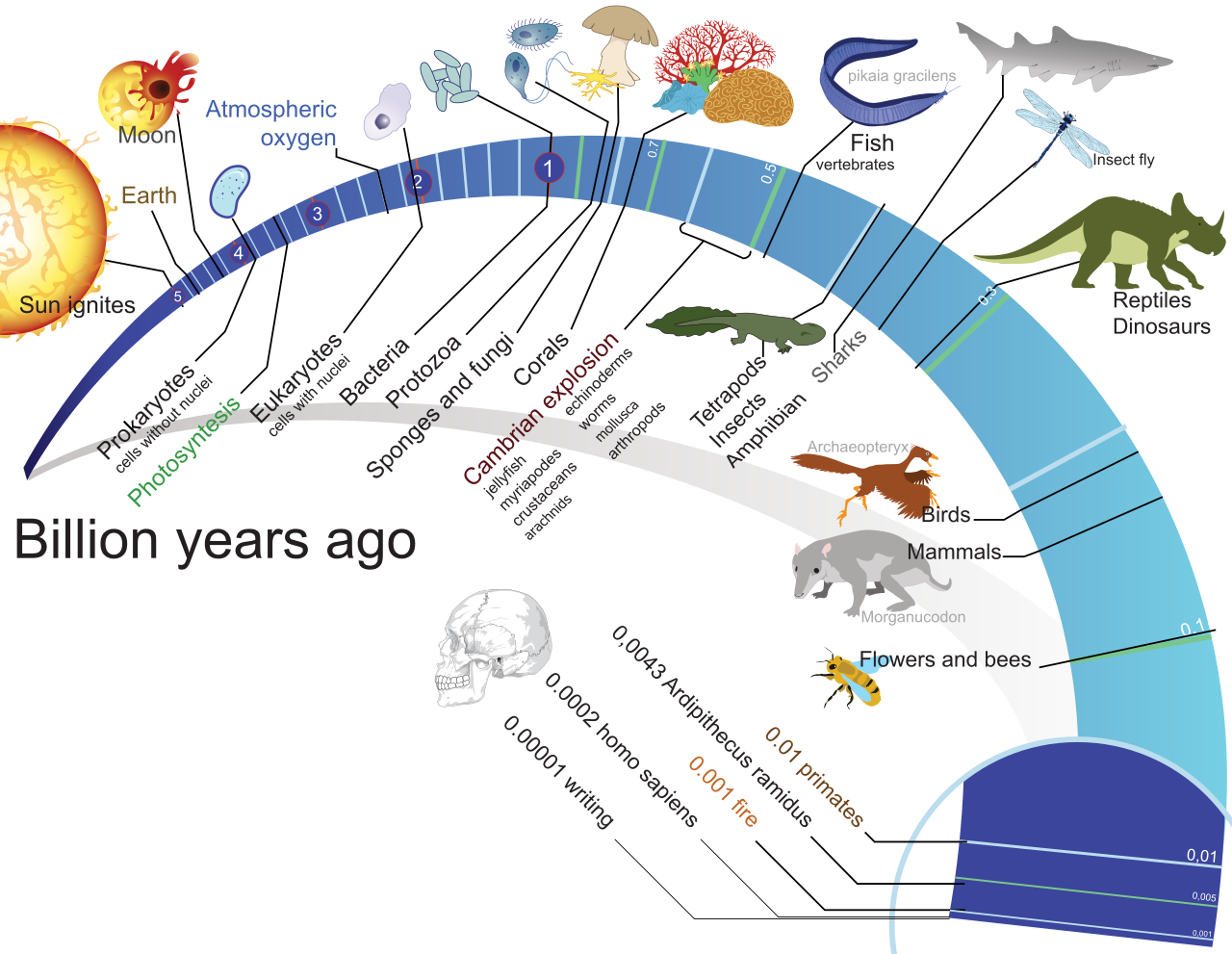
In this assignment, we made a timeline of Earth's history to better understand when and how some major events happened on our planet. We used a strip 10 meters long to represent the 4.6 billion years of Earth's history, where 1 million years was represented by 2 mm. One very significant major event is the creation of Earth itself, which happened 4.6 billion years ago. Nothing as we know it would exist if this collision did not happen to form our planet. The increase of oxygen in the atmosphere and organisms which use oxygen for life processes which happened in the Ordovician is an important event in Earth's history. This laid the foundation for processes such as photosynthesis and respiration, which are essential. The majority of organisms today are descended from these first organisms. The extinction of the dinosaurs was a very significant event in Earth's history as well. It happened during the Mesozoic Era and gave way for mammals to dominate. This paved a path for humans and other mammals to come into existence because the dinosaurs were very dominant at the time and the smaller mammals stood no chance.

In our scale, 1 million years was represented by 2 mm. It was surprising for how much of Earth's history there was no life. Being able to see this visually represented really put so much of history into perspective for me. Before doing this timeline, I knew that the Precambrian Era was 88% of Earth's history but when we scaled our timeline accordingly, I began to really understand how significant a part of history this is.

Humans have made up such a small part of Earth's history, and it is surprising how much they have changed the planet in such an relatively insignificant amount of time. Humans are now the dominant species, but have been around for not even a speck in terms of geologic time.

One question I have is, how significantly have humans changed the planet in relatively small time that they have occupied it?


Wednesday, March 16, 2016

Hunger Games Lab Analysis


1. In this lab, we simulated a population of organisms competing for survival. We wanted to model the process of natural selection. There were 3 phenotypes for picking up food in our environment: stumpys (AA), knucklers (Aa), and pinchers (aa). Corks represented food, and the food was scattered around a field. The organisms had 30 seconds to gather as much food as they could, and they had to get a certain amount in order to mate and reproduce.

2. Pinchers were the best phenotype at gathering food, because they got to pick up food with their thumb and their index finger, which was the easiest to get as much food as possible.

3. We found that the population did evolve, and the changed allele frequency is evidence for that. In the initial population, the frequency of the "A" allele was 52% and the frequency of the "a" allele was 48%. After 8 generations, the "A" allele frequency was 41% and the "a" allele frequency was 59%.

4. The genotypes and phenotypes that each organism was "born with" was completely random, the scattering of food throughout the field was random.

5. If the food supply was smaller than it was, there would have been more competition within the population for food. In this situation, the more aggressive organisms would have obtained more food regardless of their food-gathering phenotype. If there was a larger food supply, those organisms who weren't as aggressive would have a more equal chance. This parallels what happens in nature when food is scarce.

6. The results would probably have been significantly different if there was no incomplete dominance with the knucklers. The "A" allele would probably have been completely wiped out, because the stumpys' phenotype was the most difficult for gathering food.

7. In natural selection, nature "favors" individuals who have the best traits. The population evolves to look like these individuals.

8. At times when the food supply was clumped, some individuals developed aggressiveness in order to gather enough food and survive. There are many behaviors similar to this in nature, when an animal is more skilled at gathering food fast, or running from a predator. Individuals needed a place to store their food after they picked it up, and those with bigger pockets often had an advantage. In nature, certain animals will have certain genetic advantages like this over other organisms. The individuals with these strategies' phenotypes would have been more common in the population, which affects the allele frequency.

9. In nature, natural selection acts on and favors certain phenotypes, not genotypes. Populations as a whole will evolve, but not individuals.

10. One question I still have from this lab is: in nature, how much of an organism's chance of survival has to do with it's genes and how much has to do with it's learned skill set?